
Strain-wave reducers, explained: the gear inside most robot arms
Three parts, two teeth of difference, and a ratio of 100:1 in a package the size of a hockey puck. Here's how a harmonic reducer works and why humanoid makers fight over supply.
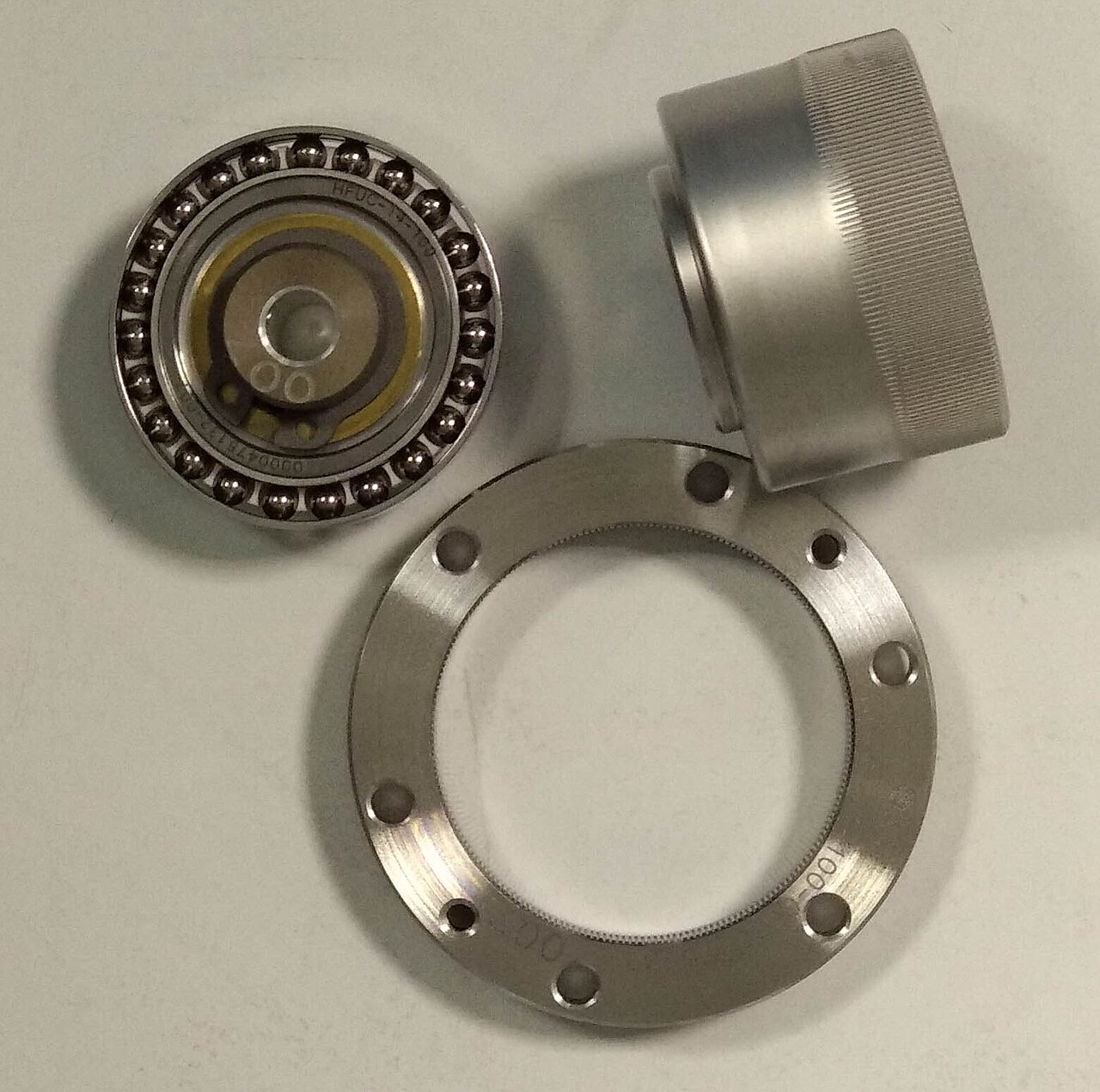 Pieceofmetalwork · CC BY-SA 4.0

A robot joint has a problem. Electric motors are good at spinning fast with little torque. Joints need the opposite: slow, precise rotation with a lot of torque. Something has to trade speed for torque between the motor and the limb, and in most robot arms and many humanoid upper bodies that something is a strain-wave reducer, often called a harmonic drive after the company that commercialised it.
The three parts
A strain-wave reducer has only three main parts:
- Wave generator. An elliptical cam with a thin, flexible ball bearing pressed around it. The motor turns this.
- Flexspline. A thin-walled steel cup with teeth on the outside of its rim. It is stiff enough to carry load but thin enough to flex.
- Circular spline. A rigid ring with teeth on the inside.
The wave generator sits inside the flexspline and pushes its rim into an ellipse. At the two ends of the long axis, the flexspline’s teeth mesh with the circular spline. Everywhere else they are clear.
Where the ratio comes from
The trick is that the flexspline has slightly fewer teeth than the circular spline, usually two fewer. As the wave generator turns one full revolution, the two mesh points travel all the way round, and the flexspline ends up shifted by just those two teeth relative to the ring.
With the circular spline held fixed and the flexspline as the output:
             teeth on flexspline
ratio  =  ───────────────────────────
          (circular teeth − flex teeth)
So a 100-tooth flexspline inside a 102-tooth circular spline gives 100 / 2 = 50:1, with the output turning in the opposite direction to the input. Single-stage ratios from about 30:1 to 160:1 are common, which is why one small unit can replace a multi-stage gearbox.
Why robots like them
- Almost no backlash. Many teeth are in contact at once and the flexspline is preloaded into mesh, so there is very little play when the joint reverses. That matters for repeatable positioning.
- High ratio in a flat package. The whole reducer is short along its axis and can be hollow through the middle for cables.
- Light. Compared with a cycloidal reducer of similar torque, a strain-wave unit is usually lighter, which helps on the arms and wrists where mass costs the most.
What they’re bad at
- Torsional stiffness. The flexspline is designed to flex, so under load the joint “winds up” slightly. Controllers have to compensate.
- Fatigue. The flexspline bends twice per input revolution, every revolution, for its whole life. Material, heat treatment and tooth profile decide how long it lasts, and this is where the know-how sits.
- Efficiency. It varies a lot with speed, load, lubricant and temperature, and is generally lower than a planetary stage.
- Shock loads. A fall or a collision can overload the teeth. That is one reason many humanoid legs use other designs.
How it compares
| Reducer | Typical use in robots | Strength | Weakness |
|---|---|---|---|
| Strain-wave (harmonic) | Arms, wrists, humanoid upper body | Zero backlash, compact, high ratio | Compliance, fatigue, shock loads |
| Cycloidal / RV | Base and shoulder joints of industrial arms | Very stiff, handles shock | Heavy, complex |
| Planetary (low ratio) | Quasi-direct-drive legs | Efficient, back-drivable, robust | Some backlash, low ratio per stage |
Why it’s a supply-chain story
The design is old. C. Walton Musser invented strain-wave gearing in the 1950s, and Japan’s Harmonic Drive Systems built a long-lasting lead making them for industrial robots. What’s new is volume. A humanoid can use several reducers per arm, and the industry is trying to go from hundreds of units to tens of thousands. That pulls in Chinese makers that have spent the last decade closing the quality gap, and it turns flexspline steel, gear grinding capacity and lead times into numbers investors watch.
On 9DOF we track those numbers in Deals and on each company page. If you work on reducers and think we’ve got something wrong here, tell us.