

Ball screws vs planetary roller screws: what goes in a humanoid leg
Linear actuators turn motor rotation into push and pull. The screw inside decides how much load they carry, how long they last and how much they cost.
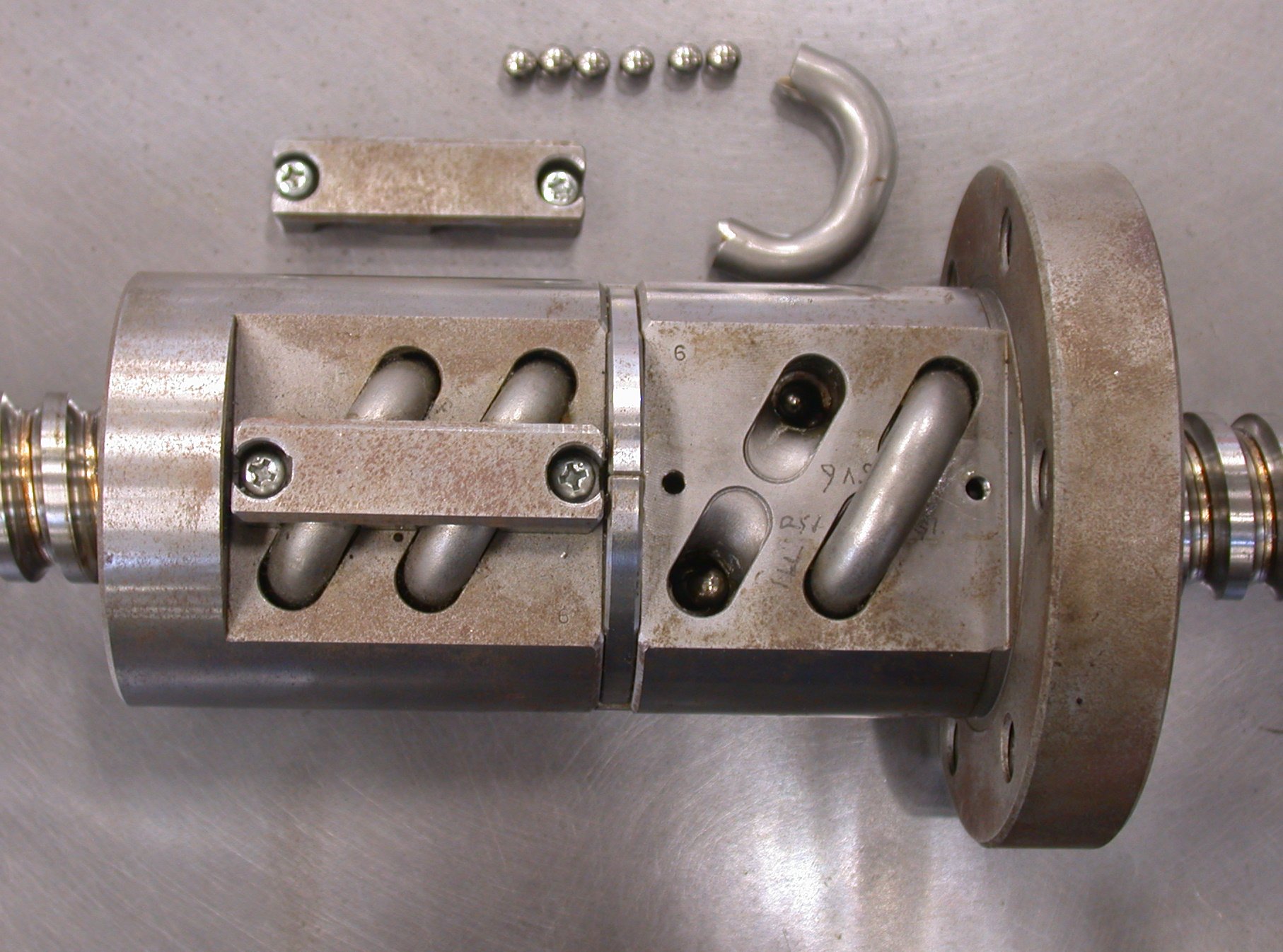 Graibeard · CC BY-SA 3.0

Not every robot joint is a rotary motor and a gearbox. Some humanoid designs put linear actuators in the legs and torso: a motor spins a screw, a nut rides along it, and the nut pushes or pulls a linkage that moves the knee, ankle or hip. The screw is the heart of that actuator, and there are two main kinds.
Ball screws
A ball screw has a helical groove on the shaft and a matching groove inside the nut. Steel balls roll between them. When a ball reaches the end of the nut it is fed back to the start through a return tube or channel, so the balls circulate continuously.
- Efficient. Rolling contact wastes very little energy, typically around 90%.
- Mature and cheap. Ball screws are standard parts in machine tools and automation, with large production bases in Taiwan, Japan and China.
- Limited load per size. Each ball touches the groove at a small point. For a given diameter, there is a ceiling on how much force the screw can carry and how long it will last under heavy, shock-type loads.
Planetary roller screws
A planetary roller screw replaces the balls with threaded rollers arranged around the shaft like planets around a sun gear. The rollers mesh with the thread on the shaft and with an internal thread in the nut, and they orbit as the shaft turns. Gears at the roller ends keep them aligned.
- More contact. Many thread flanks are in contact at once, so the load spreads over far more area than with balls.
- Higher load and stiffness in the same envelope, and a longer life under heavy, repeated loads such as walking, squatting and landing.
- Expensive to make. Precise threads on the shaft, rollers and nut all have to match. Grinding capacity and know-how are limited, and that is the bottleneck.
A variant, the inverted roller screw, puts the thread on the inside of a rotating nut-like body and lets the shaft translate. That arrangement can make an actuator more compact.
Side by side
| Ball screw | Planetary roller screw | |
|---|---|---|
| Rolling element | Recirculating balls | Threaded rollers |
| Load capacity (same size) | Lower | Higher |
| Stiffness | Good | Higher |
| Shock tolerance | Moderate | Better |
| Cost and lead time | Low, widely available | High, limited suppliers |
| Typical humanoid use | Lighter-duty linear joints | Legs, hips and other high-load joints |
Why it matters now
Tesla showed linear actuators with planetary roller screws for its Optimus humanoid in 2022, and many humanoid makers have since looked at similar architectures for the legs. If those designs scale, roller screws go from a niche aerospace and industrial part to a volume part. That is why Chinese automotive suppliers and precision-motion makers have been announcing roller-screw lines, and why we track them on 9DOF.
The open questions are cost per actuator, grinding capacity and whether quasi-direct-drive rotary joints (motor plus low-ratio planetary gearbox) win in the legs instead. We’ll keep score in Deals and on each company page.