

The 9-DOF IMU: how a robot knows which way is up
Three sensors, three axes each. Why a humanoid needs an inertial measurement unit, what each sensor gets wrong, and where our name comes from.
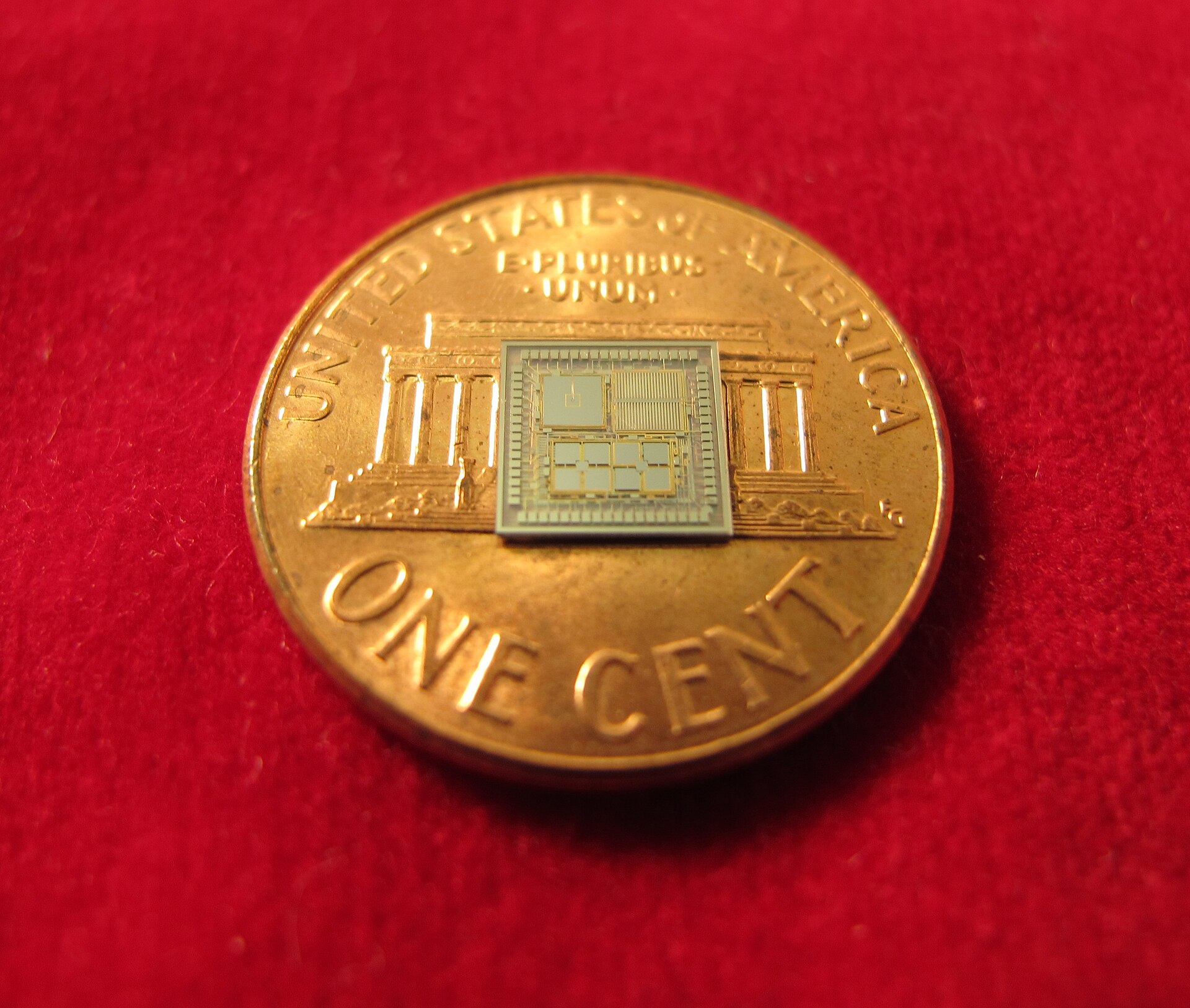 University of Michigan · Public domain

Before a humanoid can take a step it has to know how its body is tilted. Joint encoders tell it the angle of every joint, but not how the whole robot sits relative to gravity. That job falls to an inertial measurement unit (IMU), usually mounted in the pelvis or torso.
A “9-DOF” IMU combines three sensors, each measuring along three axes. Nine measurements in total, which is where the name comes from, and where ours comes from too.
The three sensors
Accelerometer (3 axes). Measures acceleration, including gravity. When the robot is still, the gravity vector tells you pitch and roll directly. When the robot is moving, its own acceleration mixes in, and the reading becomes noisy and misleading.
Gyroscope (3 axes). Measures rotation rate. Integrate it over time and you get orientation change, smoothly and with little noise. The catch is drift: tiny biases add up, and after a while the estimate wanders.
Magnetometer (3 axes). Measures the magnetic field, which gives a heading (yaw) reference like a compass. Inside a robot, it is easily confused by motors, current-carrying cables and nearby steel.
Sensor fusion
No single sensor is good enough, so the readings are combined.
- The gyroscope gives fast, smooth short-term motion.
- The accelerometer corrects pitch and roll drift over the longer term.
- The magnetometer, when it can be trusted, corrects yaw drift.
Common methods range from simple complementary filters and the Madgwick and Mahony filters to Kalman filters that also estimate sensor biases. In a walking robot the IMU estimate is usually fused again with leg kinematics, foot contact, and often cameras or lidar, to estimate the body’s position and velocity as well as its orientation.
What this means for robot builders
- Most robot IMUs are MEMS chips: tiny silicon structures made in semiconductor fabs. They are cheap, but noise, bias stability and temperature drift vary a lot between grades.
- Because magnetometers struggle near motors, many legged robots rely on a 6-axis IMU (accelerometer and gyroscope) plus other sensors for heading.
- The IMU is a small line on a humanoid’s bill of materials, but a bad one shows up straight away as a robot that can’t balance.
Why we’re called 9DOF
A 9-DOF IMU is how a robot senses its orientation in the world. 9DOF does the same job for Asia’s robotics industry: we combine many noisy signals (filings, announcements, supply-chain chatter, conference demos) into one steady picture. Like any good filter, we show our inputs. Every story links its sources.